Social Futures, Peak Oil, Relocalization
Scenarios of degrowth: an introduction to causal loop models
Monday, October 6th, 2025Prosperity in the Western world (aka the American Way of Life) has been in decline for decades, and no government since Nixon has done anything significant about it. Nor could they, in the long run. As any oil geologist knows, it is all about the end of cheap energy. All policies attempted simply to [...]
Can Western Global Elites Really Control their Endgame?
Thursday, July 24th, 2025What is Pax Americana, defined in a single sentence? Pax Americana is a globalist parasitic regime that attempts to extract wealth from the rest of the world through the imposition of a transnational financial oligarchy backed by a system of worldwide military bases and an expeditionary force that exacts obedience through financial oppression and military [...]
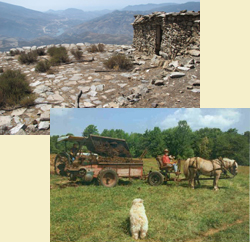
Watering the Garrotxes: donkey farming in the French Pyrénées
Thursday, March 7th, 2024A region of distinction in decline
French Catalonians commonly call their region Roussillon, but as one ascends from the coastal plain that stretches from the city of Narbonne to the Spanish border, first into the foothills, then into the narrow, steep-sided Tet river valley known as the Conflent, different landscapes take on different names. The last [...]
The Achilles Heel of the Climate Change Warriors: The limits of complexity science
Saturday, December 30th, 2023The goals of this essay are two. First, I will expand the critique of the ways we do science that I made in premise #3 of An agroecological model for the end of the oil age. My hope is to raise questions about our deeply ingrained faith in all the current methods of scientific inquiry. [...]
An agroecological model for the end of the oil age
Monday, August 14th, 2023Introduction
Modern civilization is urban down to its rural roots, hates nature, ignores nature, depends on nature, destroys nature, yet expects nature to keep on giving. Now nature is striking back. The result is a slow-motion tragedy of catabolic collapse[1], like the oroboros tail-eating snake. To withstand the collapse, a revolution in food production [...]
Increasing craziness in Western governing classes: a theory
Thursday, March 9th, 2023The best laid plans of mice and men go oft astray – from a Scots poem by Robert Burns
The highest act of love in a criminally insane society is disobedience. – John Schumacher
Bouts of collective insanity are no surprise to historians, who have detected a pattern of such spectacles in collapsing empires. We all [...]
What is causing the astonishing self-demolition of the West?
Thursday, January 5th, 2023After a successful 500-year run, why is Western hegemony slowly falling apart, and moreover, as Pogo famously said, why is it that “the enemy is us”? This essay will explore a complex of root causes, focusing on the built-in dynamics of the capitalist system, which drove it to produce the expected positive results – increasing [...]
After Collapse, What Next?
Friday, April 15th, 2022When global empires start to fall apart, the structure of interdependent elements accumulated over the years imparts an inertia that appears to sustain them for a while past their normal collapse date. In the case of the US empire, this illusory momentum, combined with a shocking degree of mendacity and deception in the mass media, [...]
An Unprecedented Geopolitical Tilt
Sunday, March 27th, 2022We are seeing a planet-wide shift in geopolitical ascendency that is political, economic and cultural, and is unprecedented in the last five hundred years. It is a slow process that one could best describe as tectonic in scale, like a slanted table set with nations all sliding in one direction, which gradually rights itself, becomes [...]
End Games of Modernity – a Convergence of crises
Tuesday, January 18th, 2022As I have written earlier in this series, modern civilization has reached an end game[1]. I am defining modernity as a form of civilization that began in the West – let’s call it EurAnglia – 500 years ago and spread in different degrees to the rest of the planet by Western imperial conquest. This essay [...]
« Previous Entries